To get a more personally relevant horoscope, start with accurate birth information and choose a forecast comparing current planetary movements with your natal chart instead of relying only on your sun sign. Look for transparent methods and clear handling of uncertain birth times.
Accuracy Begins With Your Birth Information
A more accurate horoscope begins with a precisely calculated natal chart. Before current transits can be interpreted or themes understood, the forecast needs a reliable picture of the sky at your birth. Your birth date, time, and place provide that foundation.
Your birth date: This sets the planets’ positions in the zodiac and reveals the key placements that shape your natal chart.
Your birth time: The most accurate time helps determine your rising sign and the arrangement of astrological houses. Even a small difference that does not change your rising sign can shift the ascendant and house cusps enough to affect a forecast’s timing and emphasis.
Your birthplace: Your city and country allow the chart to account for location, time zone, and local time conventions when calculating the sky from your point of arrival.
Confirm the details: Whenever possible, check an official birth certificate, hospital record, baby book, or family document rather than relying entirely on memory.
Work with what you know: If your exact birth time is unavailable, you can still gain meaningful insight from planetary placements and aspects that do not depend on it. In Lumen Compass, forecasts use rising-sign, chart-angle, and house-based interpretation only when you have explicitly confirmed that your birth time is known and supplied a time. Otherwise, these details are excluded rather than treated as reliable from an estimated time.
Bring the chart into the present: Once the natal chart is established, current planetary movements, known as transits, can be compared with it. This reveals which parts of your chart are activated and makes the forecast more personal than a message written for everyone who shares your sun sign.
The clearer the starting point, the more clearly astrology can speak to the moment you are living now.
Why Your Full Birth Chart Creates a More Personal Forecast
Your sun sign is an essential part of your astrology, but it was never meant to tell your whole story. A full natal chart brings together several layers of information, each revealing something different about your nature, experiences, and how you move through life.
 | The SunRepresents your essential identity, vitality, and sense of purpose. It describes the qualities you are learning to embody more fully and the inner direction that helps you feel most authentically yourself. |
 | The MoonReflects your emotional nature, instincts, and need for security. Its sign and house can reveal what restores you, how you respond when feelings take the lead, and what helps you feel emotionally supported. |
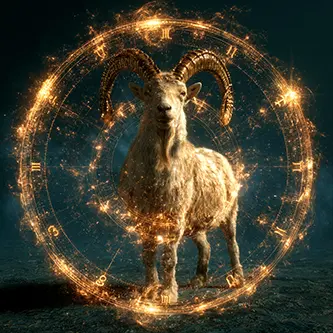 | The Rising SignYour rising sign describes how you approach life and meet new experiences. Because it establishes the starting point of the astrological houses, it also gives your chart its personal orientation and plays an important role in individualized forecasting. |
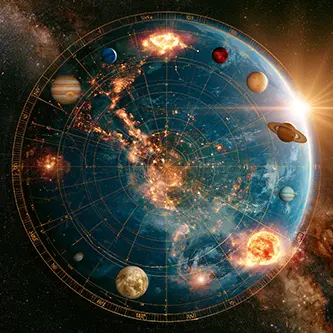 | The PlanetsEach planet represents a distinct part of your experience. Mercury speaks to communication, Venus to relationships and values, Mars to desire and action, while the outer planets reveal broader patterns of growth, change, and transformation. |
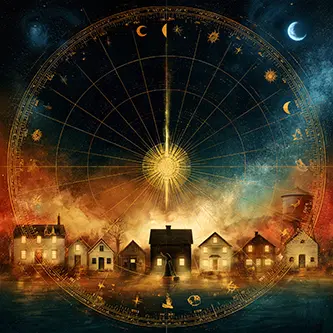 | The HousesThe twelve houses connect astrological influences with specific areas of life, such as relationships, work, home, creativity, and spiritual development. They help show where a planetary influence is most likely to receive your attention. |
 | The AspectsAspects are the relationships formed between planets in your chart. They reveal how different parts of your nature cooperate, challenge, and strengthen one another, adding depth that cannot be found by reading each placement separately. |
 | Current TransitsTransits show how the planets moving through the sky interact with your natal chart. They bring the chart into the present, highlighting changing themes, new opportunities, and areas that may be asking for greater awareness. |
No single placement defines you. A personal forecast considers how these elements work together and how current transits activate your unique chart. This transforms astrology from a general message for one zodiac sign into guidance shaped around your individual astrological pattern.
What to Look for in a Personalized Astrological Forecast
A personalized forecast should do more than name the planets moving through the sky. It should show how the most important movements connect with your natal chart, where their influence is felt, and how you can work with the themes they bring.
A connection to your natal chart: The forecast should relate current transits to your natal planets and, when your birth time is confirmed, your angles and houses. This turns a general description of the astrological weather into guidance shaped around your life.
Attention to the strongest influences: Not every transit carries equal weight. A thoughtful forecast identifies the movements that make the closest or most significant connections to your chart, rather than overwhelming you with every planetary change.
A clear sense of the forecast period: Some transits pass quickly, while others form a longer backdrop. Lumen Compass looks across your Weekly or Bi-weekly forecast period to distinguish shorter-lived influences from conditions present across more of that window. This helps you recognize the pace of the reading without promising an exact day, hour, or event.
Meaningful synthesis: Several influences may be active at once. Instead of presenting them as disconnected interpretations, a well-crafted forecast brings them together to reveal the larger pattern running through the period.
Guidance you can use: Astrological insight becomes more valuable when it connects with lived experience. Look for interpretations that help you reflect, recognize possibilities, and respond with greater awareness.
Room for your choices: A transit may describe the energy surrounding a time, but you decide how to meet it. The best forecasts illuminate the path without claiming only one outcome is possible.
A personalized forecast should leave you with more than information. It should help you understand the season you are in and move through it with intention.
Why More Techniques Do Not Automatically Create a Better Forecast
Astrology offers many forecasting methods, including transits, progressions, solar returns, and annual profections. Each technique views time through a different lens and can reveal something meaningful. Yet including every method does not necessarily make a forecast more accurate. Too many layers can obscure the message the chart is trying to convey.
A technique is most helpful when it has a clear purpose. Transits show how current planets affect your birth chart. Progressions highlight your inner growth over time. Solar returns focus on the main themes for a year. These methods work best when you choose them carefully, not just add more.
The best forecasts focus on the strongest and most consistent patterns. If several key signs point to the same theme, that makes it stand out. If small details are treated the same as big ones, the reader might get a lot of information but not know what matters most.
This matters even more when you use different systems. Western astrology, Vedic astrology, and numerology each have their own ways of working. They can give you different points of view, but it’s best to understand each one by itself before you mix them together.
A meaningful forecast is not the one with the most techniques. It is the one that recognizes what matters, harmonizes different influences, and leaves you with a clearer understanding of the path ahead.
How to Work With a Personalized Forecast Over Time
A personalized forecast is most helpful when you revisit it during the time it covers. Instead of trying to take in everything at once, start by picking out one or two themes that stand out to you.
These might relate to a relationship, a creative project, a new responsibility, or a personal change that is just starting. Think about how these themes relate to what is happening in your life right now.
A forecast might suggest it is a good time to express yourself, be patient, rethink things, or take action, but you will understand it better when you see how it fits your own situation. Notice where you already feel this energy and what it might be asking you to pay attention to.
As time goes by, watch what happens without forcing every experience to match the forecast. Notice if certain feelings, conversations, chances, or choices keep coming up. Writing short notes in a journal can help you spot patterns that might be hard to notice right away.
Go back to the forecast when the period is almost over. Some things will be clear right away, while others might only make sense after you have experienced them. Looking back can show you how you reacted, what changed, and what lessons you want to remember for the future.
When you feel at ease using your astrological forecast like this, you can also try numerology for another point of view. A Personal Month reading looks at the numbers influencing your month, giving you a new perspective while still keeping your astrology insights.
If you look at both systems on their own and then together, you might find common themes or see different sides of your experience. If you want to learn more about how astrology and numerology work together, read Astrology and Numerology: How Two Perspectives Become a Richer Personal Forecast.
A More Personal Way to Work With Astrology
An accurate horoscope starts with reliable birth details, becomes personal with your full natal chart, and gets meaning from a careful look at the transits affecting you now. The goal isn’t just to gather predictions, but to notice the influences that matter and work with them over time.
Lumen Compass brings these pieces together by comparing current planetary transits with your natal chart and selecting the strongest distinct contacts for your Weekly or Bi-weekly forecast. Its astrology forecast does not currently combine progressions, solar returns, or annual profections. Newly generated readings show your personal astrological conditions above the interpretation, so you can see the specific contacts behind the guidance; this is not a full calculation report with every orb or ranking score. Older saved readings retain their original format.
Your Personal Month numerology is read separately before the two perspectives come together in your Integrated Message. You’ll also receive a reflection based on your chosen wisdom tradition. You can try the full experience for three weeks.